
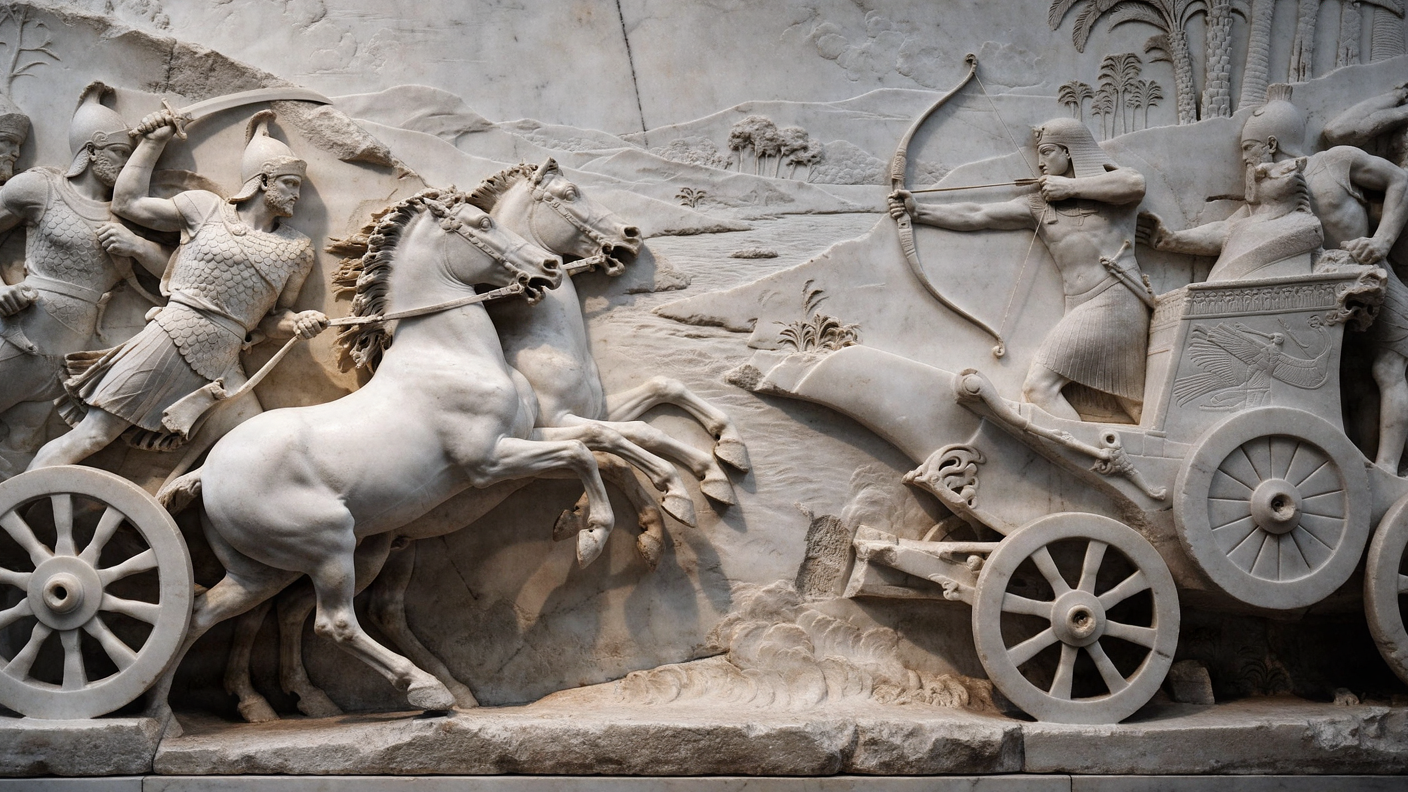
The Hittite Empire: Ancient Egypt’s Forgotten Rival
Around 1274 BCE, beside the Orontes River in modern Syria, the most powerful man in the world nearly lost everything.
Pharaoh Ramesses II was camped outside the city of Kadesh when two captured spies told him his enemy was far away. They were lying. Moments later, thousands of Hittite chariots burst from hiding and crashed into his army.
The Battle of Kadesh ranks among the largest chariot clashes in history. Yet the empire that nearly broke Egypt’s greatest pharaoh vanished so completely that, until 1906, scholars had never found its capital.
Why does it matter? The Hittites left us the best-documented peace treaty of the ancient world, a copy of which is displayed at United Nations headquarters. Their story also shows how even a superpower can vanish when its world unravels.
So who were the Hittites?
How Hittite Empire Became a Superpower
The Hittites rose on the harsh central plateau of Anatolia, in modern Turkey. They spoke Nesili, the earliest-attested Indo-European language, and ruled from Hattusa, a mountain fortress near today’s Boğazkale. They called their realm the Land of Hatti, a name borrowed from the earlier, non-Indo-European people they absorbed.
Their Old Kingdom was ambitious and violent. Around 1595 BCE, King Mursili I raided Babylon, ending the dynasty of Hammurabi. He was soon murdered, and Hatti slid into generations of palace intrigue. Around 1500 BCE, King Telipinu issued an edict regulating royal succession to curb the bloodshed, an early attempt at constitutional order.
Hittite religion was famously inclusive. Texts speak of “the thousand gods of Hatti,” a pantheon that swallowed the deities of every people the kings conquered.
Egypt, meanwhile, was ascendant. Under pharaohs like Thutmose III (r. c. 1479–1425 BCE), its New Kingdom armies pushed into the Levant and collected tribute from Syrian cities.
By the 14th century BCE, the Near East resembled an exclusive club of great powers: Egypt, Babylonia, Mitanni, Assyria and Hatti. Their kings called each other “brother,” swapped gold and princesses, and wrote in Akkadian cuneiform, the diplomatic English of the day. The Amarna Letters, a clay-tablet archive found in Egypt, preserve this world.
The prize they all coveted was Syria. Its ports, caravan routes and wealthy cities controlled the flow of metals, timber and grain. Sooner or later, Egypt and Hatti were bound to collide.
That collision would be driven by one extraordinary king.
Suppiluliuma I: The Warrior King Who Remade the Map
Around 1344 BCE, Suppiluliuma I took the throne and turned Hatti into a true empire. His masterstroke was crushing Mitanni, the power that dominated northern Syria. He seized Carchemish on the Euphrates and installed his son there as king, creating a Hittite power base deep in Syria.
His real genius was administration. Vassal treaties bound client kings, such as those of Ugarit and Amurru, to Hittite loyalty oaths, letting Hatti rule a sprawling territory without garrisoning every city.
Then came a diplomatic bombshell. A widowed Egyptian queen, called Dahamunzu in Hittite texts, wrote asking for one of his sons as a husband. According to the chronicle of his son Mursili II, Suppiluliuma found the request so unprecedented that he suspected a trap.
Most scholars identify the queen as Ankhesenamun, widow of Tutankhamun, though Nefertiti has also been proposed. Prince Zannanza set out for Egypt and died on the road, probably murdered. Hittite retaliation followed, and captives brought home carried a plague that killed Suppiluliuma himself and ravaged Hatti, as Mursili II’s anguished “plague prayers” record.
The Road to Kadesh
Rivalry over Syria simmered for generations. Pharaoh Seti I briefly captured Kadesh around 1290 BCE, but it slipped back into Hittite hands. His son Ramesses II (r. c. 1279–1213 BCE) vowed to reclaim it, especially after Amurru, once an Egyptian vassal, switched sides to Hatti.
Hittite king Muwatalli II prepared carefully. He even shifted his capital south to Tarhuntassa, then assembled a huge coalition of vassals and allies.
The Armies
Egyptian inscriptions claim Muwatalli fielded about 2,500 chariots and 37,000 infantry. Historians treat such figures cautiously, since scribes had every reason to inflate the enemy. Ramesses led perhaps 20,000 men in four divisions named for the gods Amun, Ra, Ptah and Set.
The chariots mattered most:
| Egyptian Chariot | Hittite Chariot | |
|---|---|---|
| Crew | Two (driver, archer) | Three (driver, spearman, shield-bearer) |
| Style | Fast, mobile, arrow fire | Heavier, built for shock charges |
The Battle of Kadesh (c. 1274 BCE)
The battle unfolded in four stages:
- The deception: Two Shasu nomads, planted by the Hittites, told Ramesses that Muwatalli was far away near Aleppo. Ramesses rushed ahead with the Amun division, leaving the rest strung out behind.
- The ambush: Hittite chariots swept around Kadesh and shattered the marching Ra division, sending survivors fleeing toward the Egyptian camp.
- The crisis: The chariots broke into the camp itself. By his own account, Ramesses rallied his guard and counterattacked.
- The relief: Reinforcements, known as the Ne’arin troops, arrived from the coast and struck the Hittites in the flank. Muwatalli, who kept his infantry in reserve across the river, withdrew.
The result was a bloody stalemate. Ramesses retreated south and Kadesh stayed in Hittite hands. Yet he proclaimed a triumph on the walls of Abu Simbel, Karnak, Luxor and the Ramesseum, and in a literary account called the Poem of Pentaur.
Kadesh is the best-known battle of the Bronze Age largely because Egypt turned a near-disaster into propaganda. Hittite records tell a far more sober story.
From Rivalry to the Silver Treaty
Peace took roughly 15 more years. Muwatalli’s son Mursili III was overthrown by his uncle, Hattusili III, who then faced a rising Assyria on his eastern frontier. The deposed king reportedly sought refuge in Egypt, straining relations further. Both powers eventually needed a quiet border.
In year 21 of Ramesses’ reign (c. 1259 BCE), the two kings made a treaty. The Egyptian version was carved at Karnak. A Hittite version, in Akkadian cuneiform on clay, was unearthed at Hattusa. Its key terms included:
- Perpetual peace and non-aggression
- Mutual aid if either kingdom was attacked
- Return of political fugitives
- Support for each other’s chosen heirs
Both versions called the thousand gods of each land as witnesses.
Diplomacy deepened. Queen Puduhepa of Hatti corresponded directly with Ramesses and his queen Nefertari. Around 1245 BCE, Ramesses married a daughter of Hattusili III, a union celebrated on Egyptian monuments.
Aftermath: Collapse, Rediscovery and Legacy
The treaty held. No further Egyptian–Hittite wars are recorded, and the two courts traded gifts for decades. But peace could not shield Hatti from the storm ahead.
Around 1237 BCE, Tudhaliya IV lost to Assyria at Nihriya, weakening Hittite control in the east. Then drought and famine gripped the region, and the pharaoh Merneptah sent grain to hungry Hatti. Raiders called the Sea Peoples in Egyptian records, internal rivalries and collapsing trade networks added to the pressure. Scholars still debate whether the Sea Peoples caused the collapse or merely exploited it.
By about 1180 BCE, Hattusa was abandoned and burned. Archaeology suggests the royal quarters were emptied of valuables beforehand, pointing to a gradual breakdown rather than a single invasion. Suppiluliuma II is the last king we know. Historians such as Eric Cline see Hatti as a casualty of a wider “systems collapse” of the Late Bronze Age.
Yet the story did not end. Neo-Hittite city-states like Carchemish kept Hittite and Luwian traditions alive until Assyria absorbed them in the 8th century BCE.
The empire then faded from memory, surviving mostly in the Bible’s “sons of Heth” and cryptic Egyptian reliefs. In 1906, German archaeologist Hugo Winckler began unearthing thousands of tablets at Hattusa. In 1915, Czech scholar Bedřich Hrozný showed that Hittite was an Indo-European language.
Their legacy is real. Their treaty template shaped Near Eastern diplomacy, their law code often favored compensation over harsh bodily penalties, and Hattusa is now a UNESCO World Heritage Site.
Conclusion: Written in Clay
The Hittites remind us that history favors those who build the loudest monuments. Ramesses carved his version of Kadesh across Egypt’s temples, while Hatti’s voice lay buried beneath Anatolian soil for more than three thousand years.
When finally read, those tablets revealed a rival that fought the greatest pharaoh to a standstill, then chose diplomacy over destruction. They also reveal how fragile even mighty empires are when drought, war and broken trade arrive together.
Egypt carved its victories in stone, but the Hittites buried the truth in clay, and clay, it turned out, was patient.
Frequently Asked Questions
Who were the Hittites? The Hittites were an Indo-European-speaking people who built a powerful empire in Anatolia (modern Turkey) from roughly 1650 to 1180 BCE, ruling from the capital Hattusa.
Did the Hittites defeat Egypt at Kadesh? No clear winner emerged. The battle was a tactical stalemate, though Kadesh remained under Hittite influence, while Ramesses II publicized it as an Egyptian victory.
Why did the Hittite Empire collapse? No single cause is proven. Drought, famine, Assyrian pressure, internal rivalries, the Sea Peoples and the breakdown of Late Bronze Age trade likely combined around 1200–1180 BCE.
Did the Hittites have a monopoly on iron? This is a popular myth. Iron objects are rare at Hittite sites, and widespread ironworking spread mainly after the empire fell.